


Long ago, monsoons, rivers, and wide lakes once defined North Africa’s Holocene landscape. Nomadic communities established domains and domesticated animals, flourishing amidst the comforts of a temperate world. They crafted arrowheads and basketry, fished and hunted, and moved about, leaving traces of their existence here and there. However auspicious these people’s beginnings, it seems the vast Sahara was never really meant for paradise. Water began to vanish, vegetation withering into dust along with it; all that would remain were scattered oases and the ageless Nile.
Subsequently, groups of people began to cluster around the Nile, ubiquitous in their fates to forge a new way of life. Its soil brought fertility and inundations, an opportunity for permanent settlement and agriculture. Later, they thrived in pastoralism and agriculturalism, with settlements sprawling near the southern valley or the northern delta, developing a cultural dichotomy between the two.
For a few thousand years, the people of the Nile fostered this dichotomy, but that, too, like the fickle temperance of nature, was never meant to remain. The Egypt known today arose from domination and mergence, the very foundations of pharaonic rule. Yet before two cultures would become one, there were kings, smiting foreign rivals and carving the path to a unified kingdom—kings who endure through images that echo the creature they embody, their power carried in a single, unyielding name: Scorpion.
Early Naqada Culture
Nearing the end of the Holocene and into the Neolithic era, two distinct cultures formed along the Nile. From roughly 3800 – 3200 BCE, the region of the Delta in Lower Egypt was dominated by the Maadi-Buto culture, named after its principal settlements. They practiced the domestication of animals and crops, wheel-based pottery, copper metallurgy, and traded with regions surrounding Egypt and the Mediterranean. Burials and lithics were of Levantine style. Yet, they were of little influence on the evolution of Egyptian culture compared to their southern neighbors.
The Naqada culture’s earliest phase developed alongside another early culture in the southern region. The Badarians, characterized by their agropastoral lifestyles centered around the use of cattle for nearly every aspect of survival, would later come to influence East African cultures even to this day. Still, it did not take long for the Naqada to dwarf them in comparison. The people of Naqada began their dominion over the southern reaches of the Nile by establishing small villages and settlements, cultivating the rich soil of the Nile Valley, particularly wheat and barley, and quickly accruing an impressive collection of animals. Black-topped, red clay pottery incised with scenes of everyday life, bricks, palettes for cosmetics, war maces, bearded male figures, and female fertility figures attest to the extent of their artistic accomplishments so early on. The deceased were buried with small statuettes, food, weapons, amulets, painted vessels, and palettes. Each village represented itself with a unique animal totem, perhaps its own animalistic deity as well.
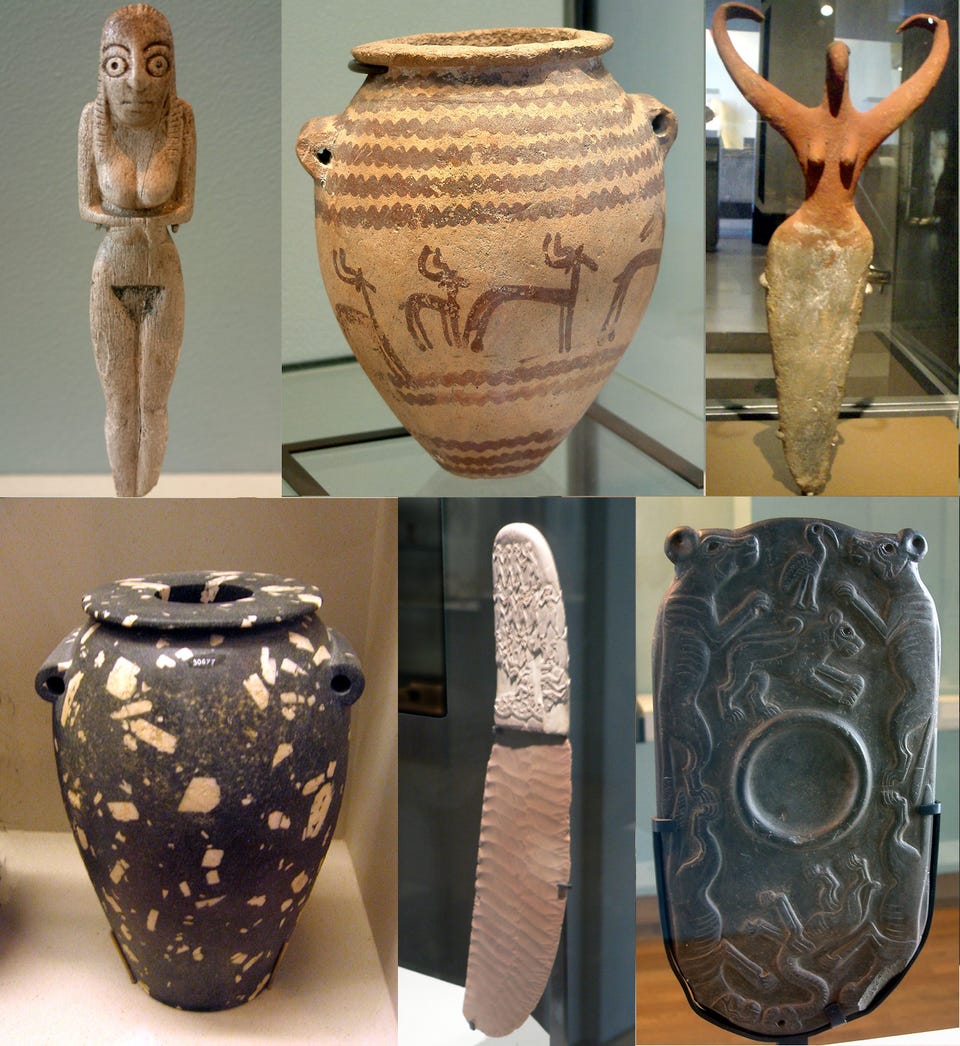
By 3500 BCE, Naqada had become masters of their craft. This specific time in Naqada history is often referred to as Gerzean (Naqada II), after archaeological finds near its village. Cosmetic palettes became ceremonial objects, flanked with intricately carved shields or animal shapes and motifs. Stone vessels, mace heads, and copper metalworks were in high demand, fostering trade with Mesopotamia and Asia. Vivid washes of red scenes painted in ochre contrasted with pale pottery, reminiscent of their Palestinian and Mesopotamian neighbors. The cylindrical seal, a Mesopotamian administrative device, was also utilized for trade. Towns, villages, and urban centers grew dense with people as previous nomadic lifestyles faded into the past, trade bolstering an already promising community.
It seemed Naqada was well on its way to distinction and prominence, so much so that its influence began to slowly make its way north. However, it was not their influence that stood out during this time. Burial rites evolved into extravagant displays with rectangular walls of wood or stone or tombs lined with ritually shattered pottery or framed in painted portrayals. Then followed grand palaces, monumental complexes, and macabrely ambitious ceremonial practices.
Nekhen, City of the Falcon, otherwise known as Hierakonpolis, was the first of its time in architectural marvels. Gods and goddesses sprang from the primordial to establish their cult centers in places like Nekhen. As such, the cult of Horus was founded as gateways gave way to a massive courtyard, encircled by small structures, not so different from the ritual precincts of early dynasties. This complex lasted until the Ptolemaic epoch, with various features found in the first pyramid of Djoser, and precious artifacts unearthed beneath its floors. It was here that Horus was said to have defeated Seth in their battle for the kingdom.
Perhaps the most notable aspect of Naqada during this time was its elite necropolis at Nekhen. Mingled among the dead were 150 or more wild and domesticated animals, now known as the world’s first zoo. Baboons, elephants, leopards, dogs, a hippopotamus, and a crocodile were all found in fixed groups or, in the case of the many canines, alongside their deceased owners. Evidence suggests the wild animals, buried with healed injuries from beatings and restraints, were kept for an extended period of time prior to their burials. The animals likely represented sacred guardians and ceremonial figures meant to aid and accompany the dead or act as votive offerings to the gods. Nevertheless, animals would continue to be employed in similar ways, whether mummified and buried or revered as manifestations of gods; their bones bore the beginnings of a culture devoted to Death’s decree.
Dynasty Zero
The third and final period of Naqada was perhaps the most pivotal in shaping Egyptian culture. It has gone by several names: Naqada III, Semainean, the Protodynastic or Predynastic Period, or Dynasty O. By this time, between 3200 – 3000 BCE, the kingdoms of Upper and Lower Egypt were clearly defined. Though Upper Egypt had ample influence, Lower Egypt in the Delta had proven itself adept in both commerce and bureaucracy. Their strategic location gave them uninhibited access to the Mediterranean’s trade-rich waters. Bustling centers like Buto, Maadi, and Tell Farka supported smaller realms ruled by their own independent kings. There was no hierarchy among them, at least one that can be seen from the archaeological record.
In Upper Egypt, kings reigned from their capital of Nekhen, far more socially stratified than those of Lower Egypt. Those who ruled personified their gods, believed to name themselves after the sacred animals that distinguished their villages. Painted and carved images show scenes of nature, rivers, plants, animals, and agriculture. Irrigation systems grew more sophisticated, allowing for plentiful cultivation and expansion. Throughout Egypt, influences from Mesopotamia continued to find their way into tombs, tools, seals, architecture, and adornments. Even early mythical creatures, like the winged chimera serpopard—Egyptian Sefer, the one who moves to the sun—found their way into early Egyptian iconography.
Yet, the people of Upper Egypt were noticeably different than those of Lower Egypt. While Lower Egypt fostered bureaucratic diplomacy, Upper Egypt did not. Iconography from the time flaunts captives and wild animals tamed before an imposing king, his hand raised in smite, a pose that would come to be known as the smiting posture. Enemies lie before his feet or are torn to bits by animals. It is clear from these images, carved upon palettes and mace heads, that the Naqada of Upper Egypt had evolved into a warring nation.
The two kingdoms of Egypt would remain relatively cooperative throughout most of this period. Their cultures were similar enough to be siblings, but different enough to establish separation. Gods like Ra, Horus, Hathor, Seth, Min, Nemty, Nekhbet, Bat, and Wepwawet gave rise to one of the most complex religious systems in the world and the eldest of Egyptian gods. Each kingdom had its own symbols, strengths, and weaknesses. Nekhbet, the vulture, governed the Nile Valley, and Wadjet, the cobra, reigned in the Delta. Lower Egypt excelled in trade, while Upper Egypt flourished in artistic specializations, weaponry, and war. The Red Crown, Deshret, pointed in the back and spiraling up in the front, sat atop the kings of Lower Egypt. In Upper Egypt, their White Crown, Hedjet, formed an eloquent mound atop their heads.
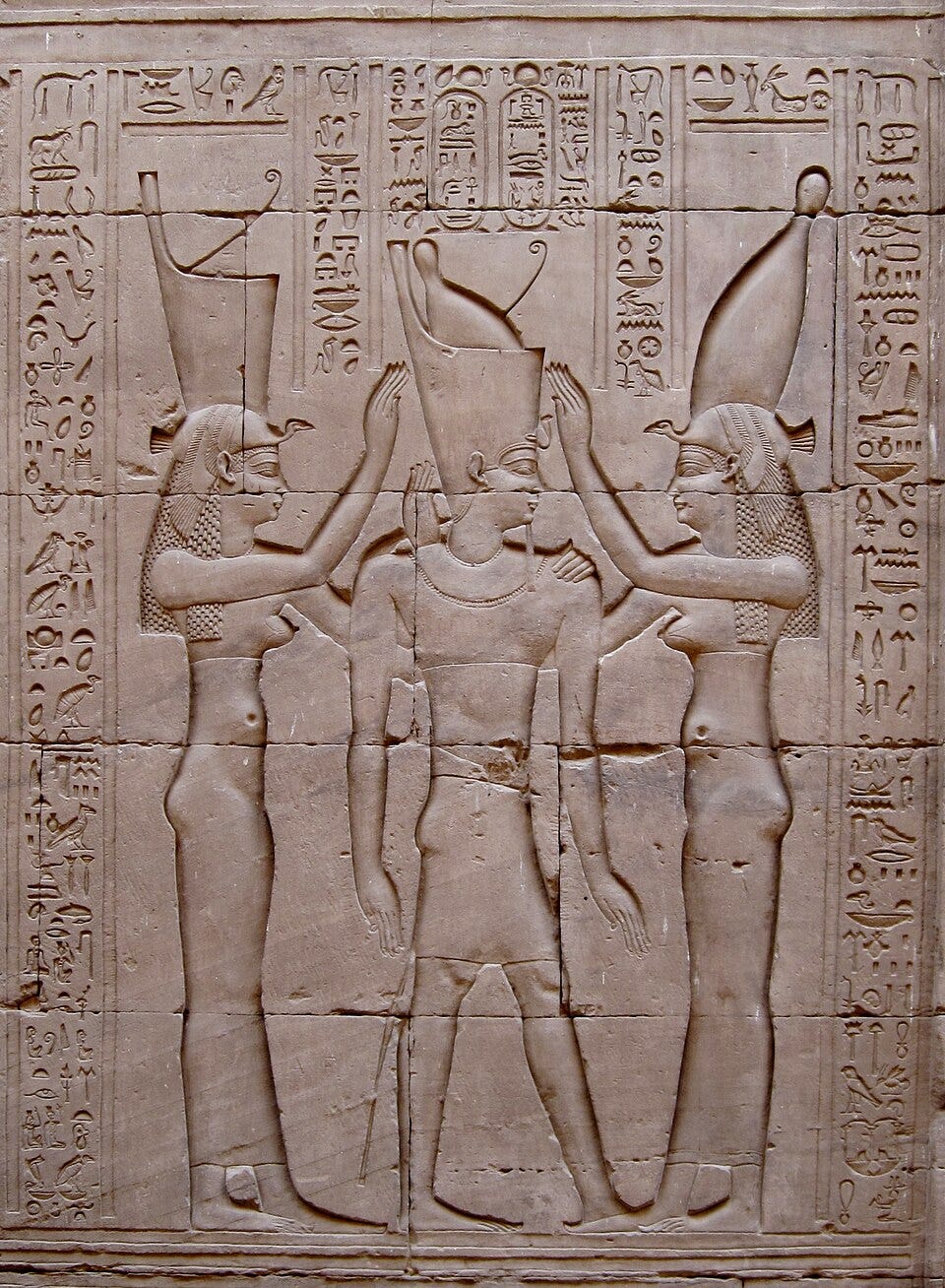
This period, however, is considered pivotal for a reason. Behind the cordialities, tension brewed as Upper Egypt became highly organized conquerors. What began as a consolidation of power would inevitably lead to the unification of all of Egypt under the pharaoh. Narmer (Menes) would be immortalized as the first king of two kingdoms, but he did not do it all on his own.
The Scorpion’s Sting
For most of the Naqada era, there were no discernible written texts, hieroglyphics, or records of kings. Kings’ lists recorded later only mention the last of sovereigns. Most of what is known of the time comes from burials, artwork, and what was left of their architecture that carried on. Echoes of the past are evident in ancient Egyptian culture, nonetheless. Towards the end of the Predynastic, hieroglyphs began to take shape; palettes, maces, and inscriptions told stories. It was clear that something extraordinary occurred that shifted control in both Upper and Lower Egypt.
There were two rulers essentially responsible for this shift in Egypt, both going by the same epithet; their true names are unknown. The first of the Scorpions was buried in a tomb at Abydos, one of the centers of power for Upper Egypt and a resting place for other Thinite sovereigns of the region. It is likely, then, that he was from Thinis, another power center of the southern kingdom. With him were small ivory plaques, two of which bear the hieroglyphic-like symbols of Baset and Buto. Buto was widely known in Lower Egypt, a place with little reason to leave behind its mark in the tomb of a Thinite king. Though perhaps, as an offering or tribute, it may point to Scorpion’s reach and army. He was indeed one of the first to depict himself in violent conquest.
To further solidify Scorpion’s role in the grand design, a graffito found etched in rock in the western desert of Thebes eternally named him as the glorious victor in a battle against Bull’s Head, a name also found within his tomb. Taken together, archaeological and iconographical evidence points to Scorpion as the uniter of Upper Egypt, fiercely conquering the kings of his realm, finally consolidating power, and making moves in Lower Egypt. It is quite likely that the offering found from Buto in his tomb was given in futile effort to sway against taking parts of the Delta as well.
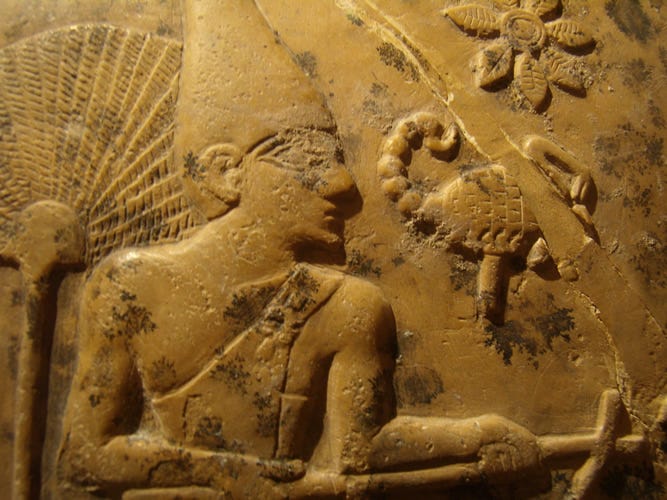
However crucial Scorpion I may have been to the union of Egypt, it is his successor whose image became a legend. Some have argued that both Scorpions are the same. Others say he was the famed Narmer himself. Neither holds credence. Though he may be Narmer’s predecessor, rival, or something entirely different. So little is truly known of the Scorpions, other than what their images reflect. Scorpion II’s tomb is still unknown, though iconography suggests it may be at Abydos or Nekhen (Hierakonpolis). What he is best known for is his ceremonial mace head, discovered at Nekhen, 25 cm in size and far too large for practical use. Upon it are vivid scenes, encompassing the entirety of its roundness in hieroglyphic-esque registers.
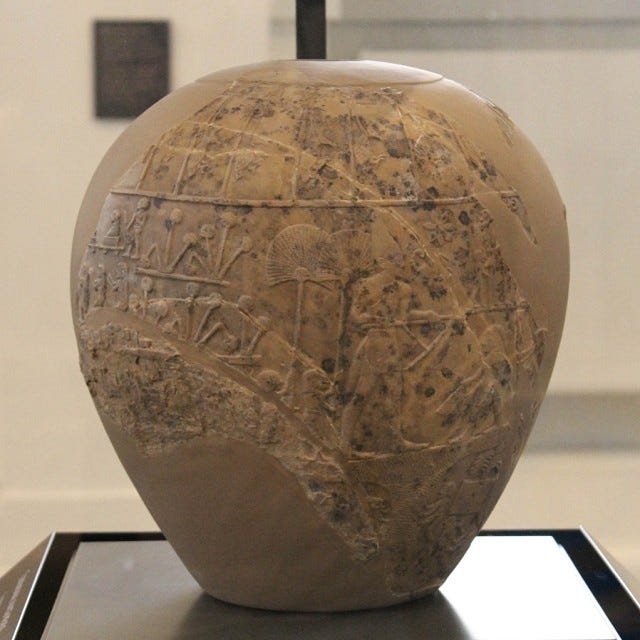
Scorpion II is shown in a hierarchical scale, with a ceremonial bull’s tail, the White Crown of Upper Egypt, and a prominent scorpion symbol. He holds a large hoe in his hands, cutting the first furrows of the season or opening the irrigation flood. A servant throws seeds; another carries bundled grain. Below them are the markings of a village, with its roads, houses, and people. Above are standard bearers, carrying their sacred symbols and staffs. Two trail the king, heavy fans drawn, while papyrus grows behind them. As the procession of bearers moves toward the king, another procession makes its way from the opposite direction. Dancers and priests in neat lines wrap around the opposite side, meeting the king just as his servants do.
In the uppermost register, rows of divine standards are mounted by their gods or the crests of nomes. On one side, ground-nesting birds called lapwings hang from these standards. On the opposite, hunting bows hang. It is believed that the bows may represent Asiatic tribes; the lapwings were the ordinary people of Egypt. For both to hang from the standards of gods and nomes suggests defeat. Modern scholars find this to be compelling evidence that Scorpion II led a campaign in Lower Egypt, possibly encountering resistance by the people while simultaneously pacifying problematic borders.
Scorpion II’s mark can also be found on ivory tags, alongside symbols for a nome, garden, or land, or next to the symbol for a swallow bird, meaning to be great. He is seen in the famed smiting pose, arm lifted in the moment before throwing down fury. Rocks and inscriptions show symbols reminiscent of the serekhs of the later pharaonic titulary. Another graffito found in the Second Cataract region of the Nile depicts the image of a massive scorpion, crushing Nubian enemies beneath its clawed pedipalps. Their bodies are dragged by a male figure who wears a false beard upon his chin and a ceremonial knife at his waist. The opportunity for unification was there, amidst the chaos of the scorpion’s sting; Narmer merely needed to follow its path of poison.
Unification Under Narmer
There are two leading theories as to how unification occurred. One states that there was increased elitism in Upper Egypt, inevitably leading to a cultural takeover, with the Naqada first dominating and consolidating Upper Egypt and then Lower Egypt. The second theory suggests that both Upper and Lower Egypt evolved through syncretism, with cultural exchange taking place between the two, ending in a predominantly Naqada culture. It is known that the Naqada were outwardly aggressive and warlike, given the plethora of artwork towards the end of the Predynastic that celebrates subjugation.
Though exchange between Upper and Lower Egypt may have been peaceful, the result, just as likely, may have been a violent clash of powers. The Scorpion mace head depicts possible victims of attack in Lower Egypt; however, the majority of enemies depicted in these scenes were iconographically foreign. Either way, around 3100 BCE, according to the ancient Egyptians, Narmer achieved unification.
The famous Narmer palette, so strikingly similar in motif and symbolism to Scorpion’s, displays the king wearing the White Crown on one side and the Red Crown on the other. On the side in which he wears the White Crown and false beard, he is in a hierarchal scale, viciously smiting a crouching enemy. The symbol for the falcon Horus is to his right, and his sandal bearer to his left. On the other side, he is depicted much smaller, along with regional standards. His enemies lie decapitated in neat rows, heads resting between their legs. In the middle, a large image of twin serpopards (Sefers) with entwined necks is held back by servants. A bull near the bottom breaks the wall of a city, a dead man at its feet. Both are topped with dual bull’s heads and a serekh at their center.
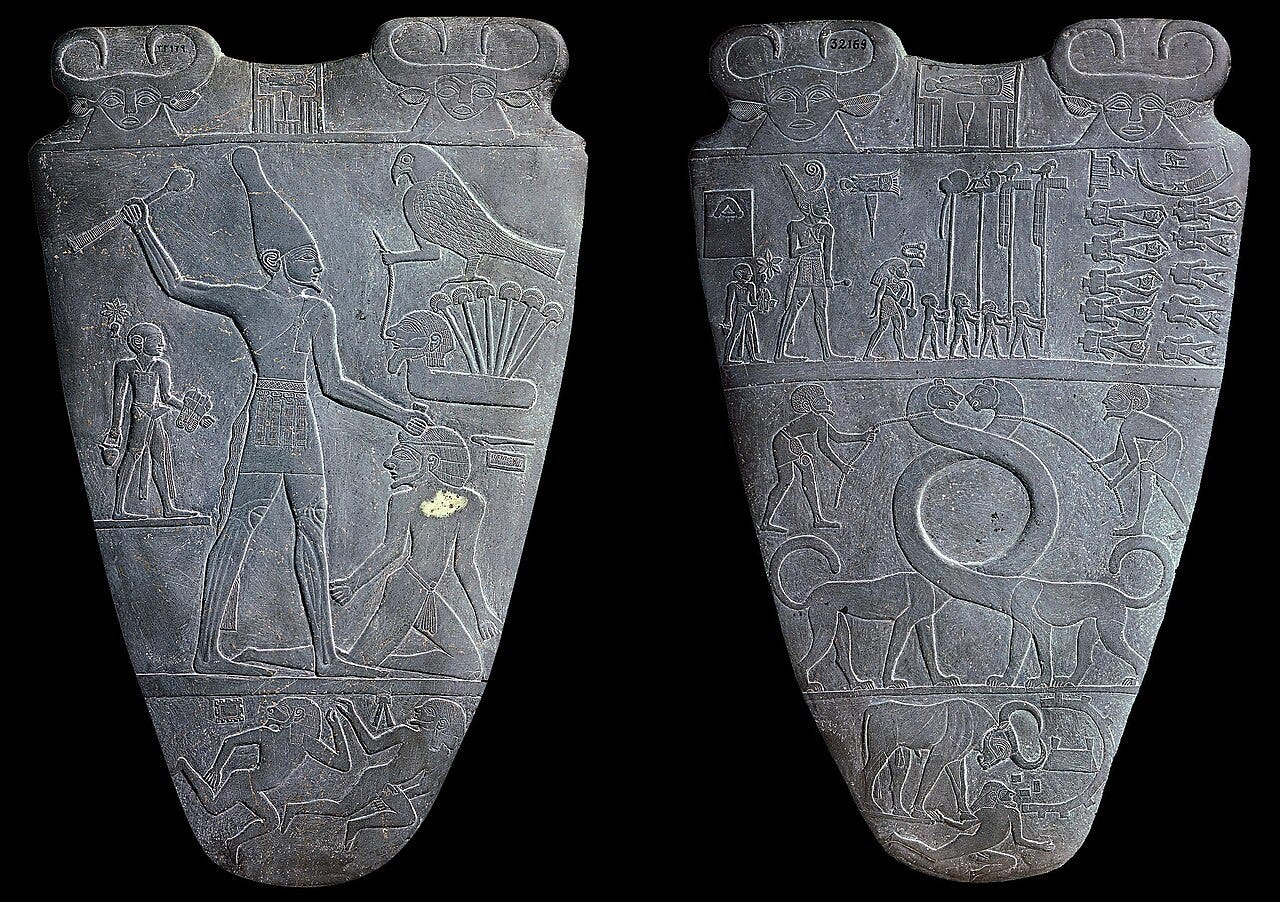
After Narmer unified Egypt, Thinis became the new seat of power for the first pharaohs. The capital would eventually move to Memphis, situated in the middle of the kingdom. Powerful families of the previous era likely fought amongst each other, struggling to control a kingdom destined for singular rule. It would have taken some time for order after the upheaval of amalgamation. The old kings of the past would soon be forgotten, some remembered on kings’ lists and iconography, but most bore names and lives never to be deciphered.
Symbol of the Scorpion
Since the Predynastic Period, the scorpion has been a fearsome symbol of veneration. Its sting was a very real hazard; females especially held a great deal more poison and were larger in size. Penetrating poison burned like flames surging through the body, causing shortness of breath, and could be fatal to children and the elderly. Medico-magical texts and formulas for the dead had numerous spells, incantations, and remedies for their venom. Its connection to the fragility of children extended to the god Horus, displayed on the Metternich Stele, vanquishing evil as he gripped serpents, scorpions, and other dreadful creatures.
The scorpion also had a deity of its own, Serqet, a goddess and protector. Her image, carved into canopic jars, protected the viscera of the dead as she guided them into the afterlife and gave them new breath. In life, she was able to manipulate the creatures of her being, either by protecting people from their stings or punishing those who spite her. Physicians who treated the wounds of scorpions were also known as her followers. Throughout tombs, her image displays a woman who carries a scorpion atop her head or as a scorpion with the head and torso of a woman.
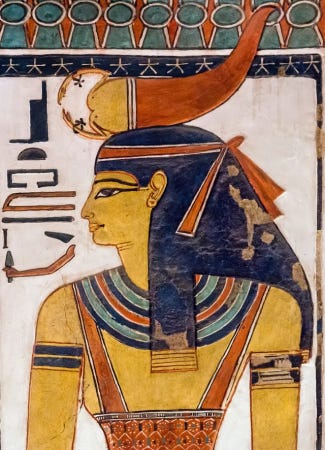
As pregnant Isis left the house of Seth, who vowed to destroy her unborn son, Horus, she found solace in the seven manifestations of Serqet. They followed her throughout Egypt as she searched for a safe place to hide her child once he was born. Traveling from town to town, she finally came upon a place to rest, knocking at the door of a woman who hastily slammed it in her face. Seven scorpions later scurried under the door and stung the hostile woman’s son. The house then caught fire, and the woman took to the streets, shrieking in horror. Isis came, calmly resting her hands on the child. The fire was extinguished, and the boy miraculously healed. Ashamed, the woman supplicated for forgiveness with gifts pleasing to the goddess.
Though history only knows the Scorpions through images on stone, they exemplify the power that the deceiving small creatures wielded over the people. They were dauntingly fierce, claiming lands as quickly as the scorpion can whip its tail, deliver its deadly venom, and watch it spread. Still, they were always more than their conquests. Just as the goddess Serqet controlled the breath of life, they gave Egypt renewed breath. Guiding the kingdoms and their future pharaoh to unification, like death guides the dead to rebirth, their actions and culture redefined Egypt into a kingdom of gods, sacred and eternal.
Featured image: King Scorpion II, detail from his mace head, Ashmolean Museum, Oxford. (Udimu, CC BY-SA 3.0)
References
Strudwick, H. 2006. The Encyclopedia of Ancient Egypt. Sterling Publishing
Clayton, Peter A. 2006. Chronicle of the Pharaohs: The Reign-by-Reign Record of the Rulers and Dynasties of Ancient Egypt. Thames & Hudson.
Brewer, Douglas. J. 2005. Ancient Egypt: Foundations of a Civilization. Pearson Education Limited. Available at: https://archive.org/stream/AncientEgypt-FoundationsOfACivilization/AncientEgypt-FoundationsOfACivilization_djvu.txt
Hill, J. 2010. Naqada Culture. Ancient Egypt Online. Available at: https://ancientegyptonline.co.uk/naqada/
El-Hennawy, H. 2011. Scorpions in Ancient Egypt. Euscorpius—Occasional Publications in Scorpiology, No.119. Available at: https://www.academia.edu/3712316/Scorpions_in_ancient_Egypt


It is fascinating that civilization, often viewed as humanity's peak achievement, actually arose from a crisis. While we appreciate personal growth through hardship, we rarely acknowledge that large-scale societal progress is fundamentally driven by collective problem-solving.
Amazing post, very well written!