


An English architect by profession and self-trained in the discipline and studies of linguistics and ancient history, Michael Ventris would be the first to identify the Mycenaean written Linear B inscriptions (1450 - 1200 BCE) as a language belonging to a more archaic form of Greek. With the aid of John Chadwick, a full decipherment of the Late Bronze Age corpus would continue from 1951 to 1953 and in turn, published for the world to see (Chadwick, 84). Unfortunately, this milestone did not provide any more insight into the still undeciphered Linear A (2500 - 1450 BCE).
Ever since I was a kid, I have been fascinated by human history. But when I got to college, that fascination turned into something much stronger, bordering on an obsession. At one point, I even made a promise to myself: I would be the one to officially translate the Minoan Linear A script.
I have not achieved that goal yet, but along the way, I have made some significant progress studying and translating what may be a closely related language. I am talking about Eteocypriot, one of two languages written using Cypriot Linear C, a modified form of Cretan Linear A. The other, of course, was Greek.
The purpose of this article is simple: to bring renewed attention to Eteocypriot, one of Europe’s ancient languages that still remains undeciphered, and hopefully spark the same curiosity and fascination in others that has kept me digging into the past for so many years.
A Brief History Lesson
There was once a time when the ancient island of Cyprus had its own native language; a language which was not Greek. Modern scholars routinely refer to this pre-Greek language as Eteocypriot or “True Cyprian.” Derived from the Minoan Linear A, the language was written in the Cypriot syllabary or the Cypro-Minoan variant which would later evolve to Linear C. However, during the 10th century BCE, the language was competing with the Arcadocypriot Greek dialect and eventually became extinct in approximately the 4th century BCE. To this day, the Eteocypriot language remains undeciphered and the mystery surrounding it continues.
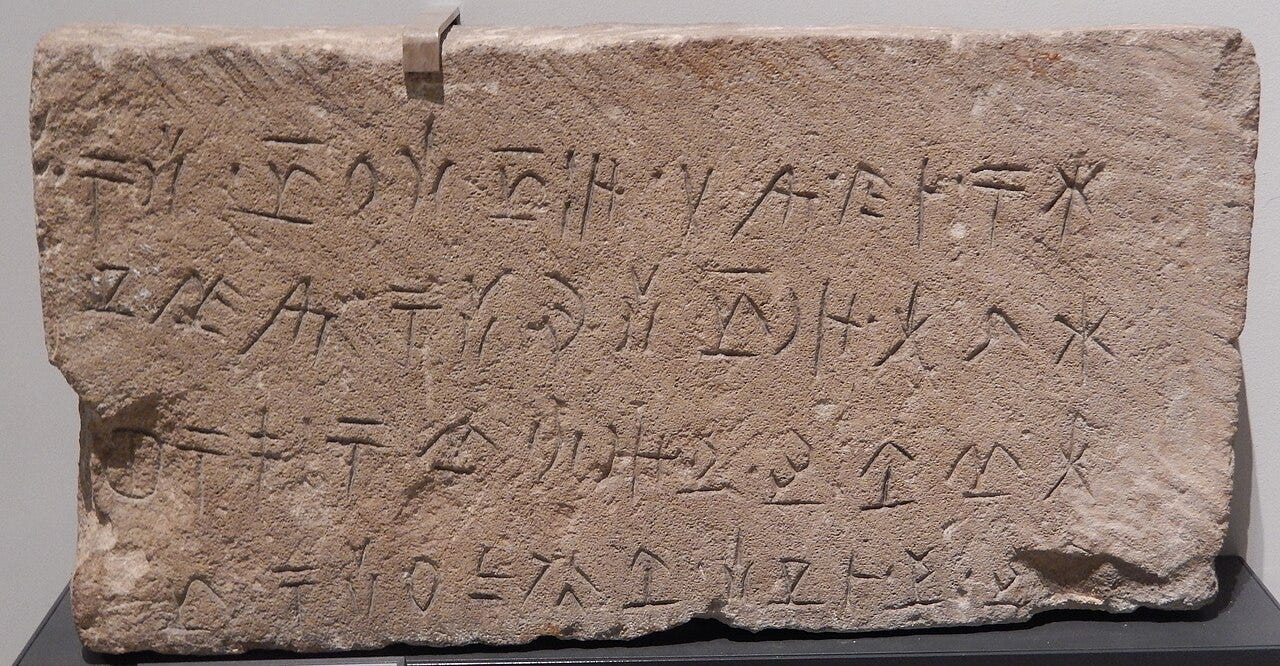
Initially discovered in 1913 at the acropolis of Amathus, Cyprus, and written on a black marble slab, the Amathus bilingual (ca. 600 BCE) contains the most famous non-Greek inscription written with this Cypro-Minoan syllabary. It is a dedicatory inscription from the city of Amathus to the noble Ariston. As mentioned earlier, the script bore uncanny similarities to that of the Minoan Linear A which immediately earned its title of Cypro-Minoan. In the same fashion as both Linears A and B, the newly discovered system of writing was identified as a syllabary where each sign represents a consonant followed by a vowel. This bilingual is thought to hold the key to deciphering the language of the Cypriots prior to Greek colonization. The Eteocypriots who objected to the rule of the Greeks, gathered to the south of the island at Amathus where they continued on with their Eteocypriot language and more indigenous Cypriot culture (Karageorghis, 114).
