



By Gil Kidron
An old Jewish joke says that for every two Jews, you have three opinions, but that could also apply to biblical scholars.
Because no two biblical scholars can agree on anything, and they oftentimes disagree with themselves, eagerly hedging their own theories, proposing counter-options.
It is true that academics quarrel over theories for a living, but biblical scholarship takes it to a whole other level and is notorious for the complete lack of agreement on even the most basic views on the Bible.
Who wrote what and when? For every two biblical scholars, you’ll get three opinions
But there’s one theory that is an exception to this rule.
There’s one biblical scholarship theory out there that everyone seems to agree on and nobody in the last 150 years has tried to dismantle it. Even though it’s a dramatic and bold theory about who wrote what and when. It’s very specific - it says that the biblical book of Deuteronomy was written no later than 622 BCE, and most probably in 622 BCE itself.
It is extraordinarily rare for biblical scholars to commit to such precise dating, a practice they usually try to avoid like the plague of pestilence.
This popular theory though does not seem to have been properly scrutinized, and this is where this little post comes in.
Let me present the theory so I can debunk it and propose a different dating for the writing of Deuteronomy.
First, the details: in 1805, the German biblical scholar Wilhelm Martin Lebrecht de Wette proposed dating of Deuteronomy to 622 BCE because of a biblical account that can be found in 2 Kings 22-23, set in 622 BCE, where an ancient book is found, or “found”, and that book sure seems like it was Deuteronomy.
That means that a biblical book, Deuteronomy, that appears near the beginning of the Bible, was written at a time of events that take place much later in the Bible, around 2 Kings.
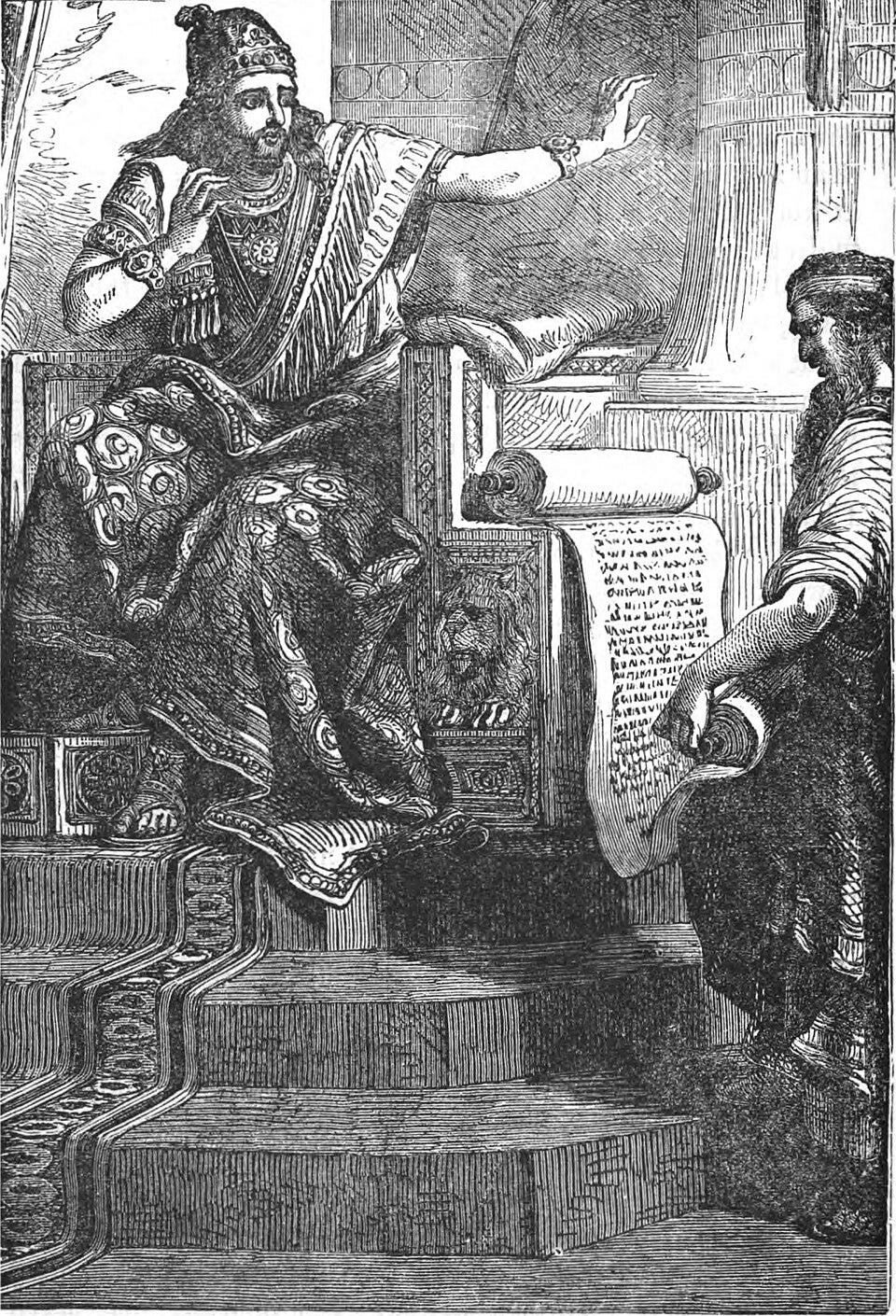
As the account, or “account”, goes, the High Priest of the Jerusalem Temple handed to the royal scribe a scroll he stumbled onto in the Jerusalem Temple as it was being renovated. The royal scribe read this scroll aloud to the Judean King at the time, in one of the most dramatic moments in ancient Hebrew history, according to the theory.
After hearing the contents of this book, the Judean King felt compelled to radically reverse centuries-long religious traditions and policies to adhere to the ones mentioned in this book.
In practicality, it meant purging all non-Yahweh religions in Judea, destroying and defiling countless shrines and executing offending priests. And destroying all shrines and altars dedicated to Yahweh, to make the Jerusalem Temple the only place allowed for Yahweh worship, and any worship really.
What a dramatic moment, about which we can read in 2 Kings 22-23. Let’s read a little, beginning in chapter 22, verse 8:
“The High Priest Hilkiya said to Shaphan the scribe, “I have found the book of the Law in the House of Yahweh… Shaphan then read it aloud to the king. When the kings heard the words of the book of the law, he tore his clothes… ‘our ancestors did not obey the words of this book.’”
And then in 2 Kings, 23, 2 and onwards:
“The King went up to the House of Yahweh, and with him went all the people of Judea, all the inhabitants of Jerusalem, the priests, the prophets, and all the people, both small and great. He read in their hearing all the words of the book of the covenant that had been found in the House of Yahweh.”
According to this De Wette 1805 theory, Josiah read Deuteronomy to the people on that day in 622 BCE.
Why? Because the book 2 Kings 22-23 refers to is called the Book of the Law (Torah) and the Book of the Covenant (Brit), which are the two main names of Deuteronomy, according to Deuteronomy.
And if we wanted to list the top two laws of Deuteronomy, they would be purging all non-Yahweh religions from the Hebrew land and abolishing any Yahweh worship outside the Jerusalem Temple, exactly the new policies enacted by Josiah in 622 BCE, according to the biblical account.
Scholars take this biblical account at face value, assuming that if it is set in 622 BCE, then it must reflect events that happened in 622 BCE.
Let’s go back to 2 Kings, 23, beginning in verse 4:
“The king commanded… to bring out of the temple of Yahweh all the vessels made for Ba’al and Ashera, and for all the host of heaven. He burned them outside Jerusalem… He deposed the idolatrous priests… broke down… defiled… burned [their altars], broke the pillars in pieces, cut down the sacred poles and covered the sites with human bones.
He slaughtered on the altars all the priests of the high places who were there and burned human bones on them.”
That’s what Deuteronomy calls on the Hebrews to do: destroy and defile all shrines and execute idol worshipers.
And one final link between the scroll King Josiah read and Deuteronomy is that Josiah is said to have loved Yahweh “with all his heart and with all his soul”, which is precisely what Deuteronomy asks the Hebrews to do throughout Deuteronomy.
So, on the face of it, it seems airtight: same two names of the book, same top two laws of the book. Meaning that Deuteronomy was written no later than 622 BCE, in the Kingdom of Judea during Assyrian Times. As long as you don’t look any closer than that, don’t scrutinize the theory or think about it some more, it’s pretty much an open and shut case.
But since we’re already here, let’s think about it some more, and we’ll see that things do not stand up to scrutiny.
The theory hinges on this uber dramatic moment in Hebrew history - a stunning, sudden and violent reversal of long-standing religious traditions, plus destroying, burning, defiling and slaughtering.
One can only imagine the pain felt on the receiving end, their rage, their trauma. One can also only imagine what it was like for the perpetrators and collaborators with these purges. One can only imagine because the Bible has nothing more to say about this dramatic moment. Once you turn the page on 2 Kings, 23, it’s as if this dramatic purge, slaughter, and centralization never happened, because nobody knows it happened. Even Yahweh doesn’t remember it one page later.
Yahweh will complain about the Hebrew people committing many sins towards him, but he will never mention them failing to follow this new covenant and law, supposedly enacted in 622 BCE by Josiah.
Once we turn the page, literally, from 2 Kings, 23 to 24, the whole things disappears. Evaporates. As if it never happened. Poof.
That should have been a red flag for biblical scholars that something is off with the “accounts” of the finding of this scroll and the ensuing radical religious reforms. If this was supposed to be one of the most dramatic moments in Hebrew history, why did it just go poof and everyone immediately forget it ever happened? How could a purge and slaughter disappear so quickly? If this reform didn’t change anything at all, then how can it have been so important?
Usually, when religions are purged, people talk about it, argue for or against it, they mourn or gloat. Except this one. No one cares about this dramatic religious reform. Josiah dies at the end of 2 Kings, 23, and that’s that.
Basically, the “accounts” in 2 Kings 22-23 could have been added to the book at a later stage, after the rest of the Bible was written, and that would explain why the rest of the Bible is not aware of Josiah’s reform. So, instead of 622 BCE, we should look for a later date that matches Deuteronomy’s purge, slaughter and centralization policies.
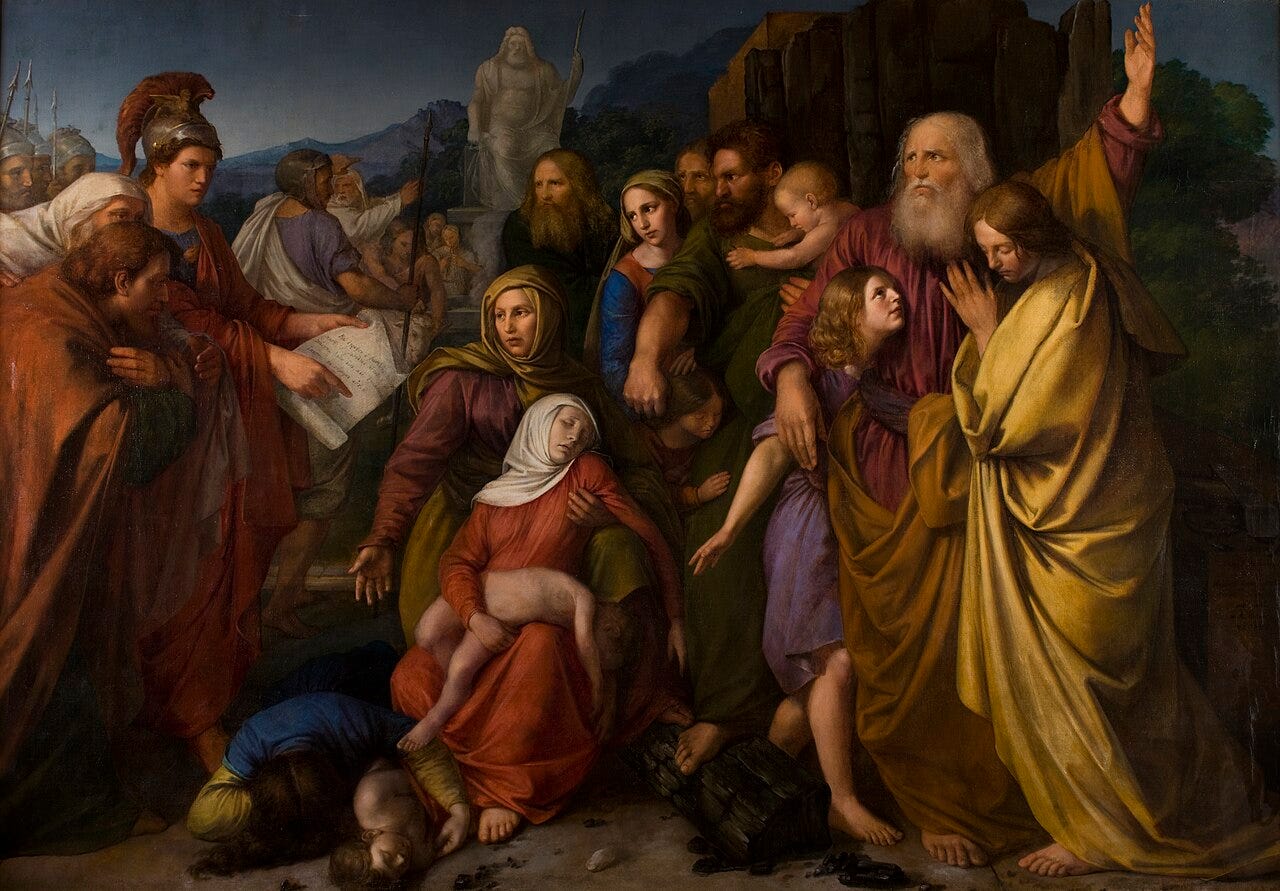
There was one later point in history when the Hebrew leader purged all foreign religions from the land, executed idolatrous priests and centralized Yahweh worship in Jerusalem – when the Maccabees established an independent Hebrew state in 140 BCE.
Interestingly, Deuteronomy is a book about the renewal of national Hebrew sovereignty over the Hebrew land, completely irrelevant for the Judean Kingdom of 622 BCE, and totally in line with the establishment of the Maccabean Hebrew state. That state conquered and confiscated the lands and wealth of their enemies, and Deuteronomy calls to divide up the Hebrew land among the Hebrew people. Deuteronomy is a populistic book, and the Maccabees were populists.
King Josiah was not a populist and he did not redistribute any land to the people in 622 BCE, because that would be anathema of kingdoms at that time.
In reality, the closer you look at Deuteronomy and compare it with the rise of the Maccabean state in 140 BCE, the more similarities you will find between them.
Non-Yahweh worship was banned once and for all in 140 BCE, Hebrew idol worship stopped being a thing, other altars, shrines and temples under Hebrew Maccabean sovereignty were destroyed, the Jerusalem Temple was the only sanctioned place of worship - all prominent elements of Deuteronomy.
I have recently concluded my fifth season of the podcast, focusing on Deuteronomy, and the closer you look at Deuteronomy, the more you find Maccabean 140 BCE elements in it.
Basic Jewish law, such as the Shabbat, circumcision and Kosher food are all staples of Deuteronomy, and they appear in the historical record only after 140 BCE.
Deuteronomy calls for the expansion of Hebrew borders beyond the Jordan River, which the Maccabees did. Deuteronomy has complex and rich Hebrew that is more evolved than anything else in the Torah, which works with it being a Maccabean addition. If Deuteronomy was written no later than 622 BCE, that causes a problem since so much of the Bible is firmly dated to Babylonian and Persian times. That would mean that the Hebrew language is the one language in history that does not evolve naturally, but that it sometimes evolves, then devolves and evolves again.
That would be a first.
At the end of the day, the theory that dates Deuteronomy to 622 BCE relies on taking the Bible’s word that the text of 2 Kings 22-23 is truthful and correct, and not, God forbid, a later addition that the Maccabees added in 140 BCE.
If the Bible said Deuteronomy was found in 622 BCE, then that must be true.
I propose dating Deuteronomy to 140 BCE, relying on identicalities between the Maccabees and Deuteronomy in geopolitics, politics, religion, worship, ideology and economy.
And then, there’s also linguistics.
Biblical scholarship has, unfortunately, not considered the possibility that parts of the Bible were written by the Maccabean state in 140 BCE. That’s a stone they left unturned. If they were to one day turn it, they will find there more than an ancient law scroll.
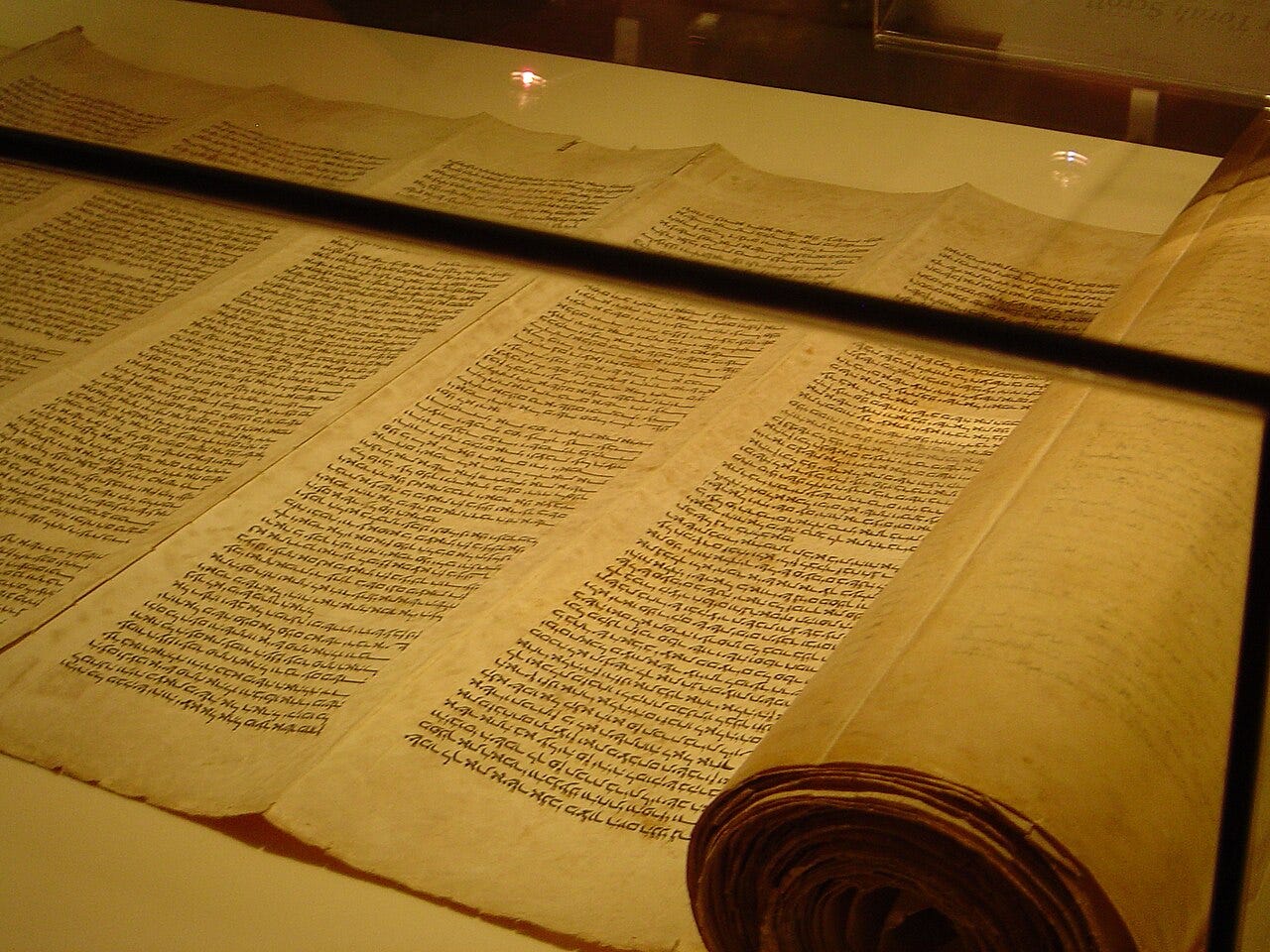
Featured image: A side view of the Torah, open to the Book of Exodus. (Bejinhan / CC-BY SA 3.0)
A Podcast of Biblical Proportions goes over the entire Hebrew Bible, story by story, book by book, trying to understand the people who wrote them. You can learn a lot about people from the stories they wrote, and you can learn a lot about the time they lived in. Gil Kidron is a Hebrew-speaking writer and editor.
To listen, visit: https://podcastofbiblicalproportions.com


