


Table of Contents
From the Editor
Another week of work taking up much of my free time but I do have a new podcast recording and video planned for the next two weeks. So, bare with me as I get through this.
Anyways, archaeologists have made some remarkable discoveries, from a possible 4,700-year-old shipwreck off Türkiye that could be the oldest ever found to enormous statues of Ramesses II emerging from the sands of Egypt. Elsewhere, excavations at ancient Arsinoe are uncovering a columned building that sheds new light on the settlement’s history, while a child’s grave in Bulgaria has yielded gold earrings and a Roman coin dating back nearly 1,750 years. Meanwhile, new research into a 2,200-year-old Etruscan bronze statue suggests its dark finish may have been deliberately created, challenging what we thought we knew about ancient sculpture. From forgotten buildings to lost ships and surprising artistic techniques, these discoveries are revealing fascinating new details about how people lived, traded, and created thousands of years ago.
Ask Me Anything
It has been a while since I have done an Ask-Me-Anything video, so, now is your chance to start asking your ancient history focused or Digging Up The Past questions! And once I get enough, a new video will be recorded!
In the News
1. A Columned Building Emerges at Ancient Arsinoe
Archaeologists excavating the ancient Greek settlement of Arsinoe have uncovered a square building with a columned courtyard, along with pottery, bronze coins, roof tiles, and animal bones. The structure appears to have been rebuilt and used over several periods, offering new clues about how the town developed. Further excavations and surveys are planned to reveal more about its layout and history. Source: Archaeology Magazine.
2. Gold Earrings Found in a 1,750-Year-Old Child’s Grave
Archaeologists in Stara Zagora, Bulgaria, have discovered a Roman-era child’s grave containing two gold earrings and a coin minted during the reign of Emperor Aurelian around AD 274 to 275. The burial was part of a larger cemetery containing 135 graves, revealing a range of burial practices in the ancient city of Augusta Traiana. Although the child’s identity remains unknown, these personal objects offer a poignant glimpse into life and death nearly 1,750 years ago. Source: Arkeonews.
3. Giant Statues of Ramesses II Unearthed in Egypt
Two enormous statues believed to depict Ramesses II have been uncovered at Behbeit El-Hagar in Egypt’s Nile Delta after a local resident reported finding a carved granite block. The first statue’s head alone stands about 1.6 meters tall, and archaeologists estimate the complete monument may have reached roughly 8.5 meters in height. Excavations are continuing in hopes of recovering more fragments and learning how the statues fit into the history of this important ancient religious site. Source: Archaeology Magazine.
4. Was This Etruscan Statue Deliberately Made Black?
A new study suggests that the famous Etruscan bronze statue known as the Orator may have been deliberately given a dark finish more than 2,200 years ago, rather than turning black solely through natural corrosion. Scientific analysis identified layers of copper compounds consistent with controlled heating, suggesting the statue’s original appearance may have contrasted a dark surface with reddish details on its clothing. The discovery challenges assumptions about how ancient bronze sculptures were meant to look and highlights the sophistication of Etruscan metalworkers. Source: Greek Reporter.
5. The World’s Oldest Known Shipwreck Found Off Türkiye
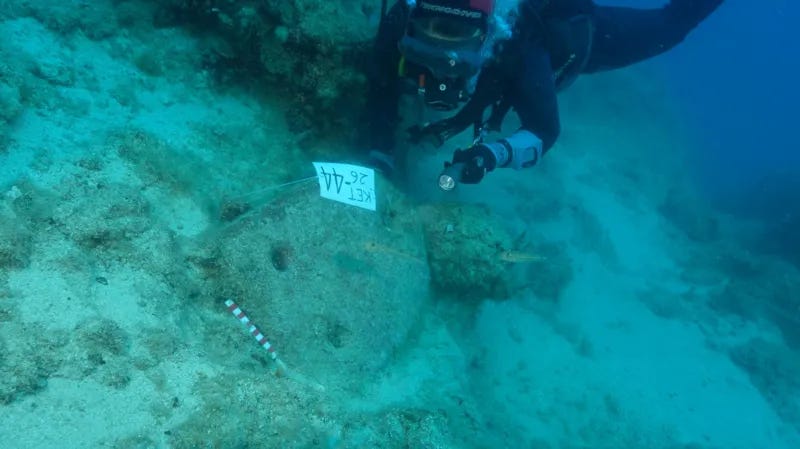
Archaeologists exploring the waters near Kekova Island off Türkiye’s southern coast have discovered a shipwreck believed to date back approximately 4,400 to 4,700 years, potentially making it the oldest known shipwreck ever found. The Early Bronze Age vessel carried ceramic containers, offering a rare glimpse into maritime trade and seafaring long before the rise of many familiar ancient empires. Researchers hope the discovery will reveal more about the people who sailed these waters and the trading networks that connected early communities across the Mediterranean. Source: BBC News.
Quote
Poetry is finer and more philosophical than history; for poetry expresses the universal, and history only the particular. - Aristotle
Trivia Question
Last Week’s Trivia Answer
While its crew and cargo reflected connections to multiple Late Bronze Age Mediterranean civilizations, the Uluburun ship belonged to a Syro-Canaanite (or Phoenician/Canaanite) merchant culture.
Halloween Sale on Annual Subscriptions
Digging Up The Past is offering a Halloween promotional sale which ends on October 31st. Be sure to not miss out on getting 20% off annual subscriptions for all eternity! Mhua ha ha ha!
Your subscription helps support the interviews, videos, and other content that make this site possible. Many of the tools, resources, and guest appearances come with a cost, so your support really does make a difference.
Thanks for being here and helping me keep creating and sharing more with you!
Featured Image: Divers find three stone anchors. Source: Hakan Öniz.