


From the Editor
Coming off the heels of the latest podcast episode and my conversation with Fred Drogula still fresh in my head, the fact that we are observing more and more adults shifting towards Classical Studies continues to fascinate me. It was discussed more thoroughly in the latter episode but the general rationale is that at some point in an adult’s life, after they establish their careers, the dust settles on expanding their families, etc., adopting stoic teachings is a way in which one can calm the chaos in their life. That is one such example. Another rests more in the idea that the history of that period interests them and as an adult, they are then able to carve out a bit of time to learn more.
What are your thoughts on Classical Studies? Is it a dying fad, or is it more alive than ever?
Either way, I will often find myself revisiting the writings of ancient Classical authors. I don’t always need a reason either.
Another topic which may be of interest is a new feature to the publication. I have been posting short videos called One-Minute Dig. These videos are designed to be a fun source for quick and fascinating historical facts. I do hope you enjoy them. If you have any thoughts or ideas for future videos, then do not hesitate to reach out. The more obscure and lesser known, the better.


Let me know what you think of them or if you have any interesting historical topics for future episodes.
In the News
Roman Shipwreck Packed With Amphorae
A 2,100-year-old Roman shipwreck carrying around 500 amphorae has been discovered off the coast of Sicily. Found about three miles from Mazara del Vallo, the vessel offers a fascinating look at the Mediterranean trade networks that connected the ancient world. Source: The Guardian.
A Nile Delta Necropolis Used for Thousands of Years
Archaeologists have uncovered a necropolis at Kom El-Khelgan that was used from the Predynastic period all the way into the Greco-Roman era. The site includes ancient graves, homes, grain silos and ovens, giving researchers an unusually long look at how people lived and buried their dead in the Nile Delta. Source: Archaeology Magazine.
The Tomb of King Midas’ Father?
A massive burial mound at ancient Gordion is now believed to contain the tomb of Gordias, the father of the legendary King Midas. The remarkably preserved wooden chamber and nearly 100 bronze brooches offer a rare glimpse into Phrygian craftsmanship and elite burial practices. Source: Archaeology Magazine.
A Wrestler’s Tomb Discovered at Aspendos
Archaeologists working at ancient Aspendos in Türkiye have uncovered a 2,400-year-old tomb that may have belonged to a wrestler. Coins depicting wrestlers found inside the tomb provide an intriguing clue about the identity of the person buried there and open a new window into the city’s Classical-era history. Source: Anadolu Agency.
Could This Be Evidence of Egypt’s Lost City of Msen?
New discoveries at Tel Abu Saify are adding to the evidence for a possible connection with the long-lost Egyptian city of Msen, including an inscription associated with Ramesses II. The findings could help researchers piece together the history and location of a city that has remained elusive for centuries. Source: The Media Line.
A 2,500-Year-Old Etruscan Treasure in a Well
Archaeologists excavating the Etruscan city of Kainua have uncovered remarkably preserved bronze objects hidden inside an ancient ritual well. Two female statuettes and a rare bronze bowl appear to have been deliberately deposited as offerings, suggesting the well may have played an important role in religious ceremonies. Source: HeritageDaily.
Quote
Hope is the dream of a waking man. - Aristotle
Poll Question
Last Week’s Poll Answer
During a naval battle in 184 BCE, the Carthaginian general, Hannibal, reportedly used clay pots filled with live, venomous snakes as a biological weapon hurled onto enemy decks.
———
And the Poll from August of last year (many apologies, I suck, I know):
The question was: King Leonidas and his 300 Spartans held the pass of Thermopylae and the Persians were unable to break through until which traitor led the vanguard of the Persian army over the mountain?
And was featured in the editorial newsletter:

The correct answer is Ephialtes.
Reminder: Paid Subscriptions and the Chat are Back!
Another thing worth sharing is that Paid Subscriptions are re-enabled! As a paid subscriber, not only will you get special access to both videos and special articles but your contributions will help support my project to continue providing the content you enjoy.
Expect to see fresh new paid subscriber content soon!
Starting today, Digging Up The Past is offering a Halloween promotional sale which ends on October 31st. Is it a bit early for a Halloween promotion? Nope! It is never too early for anything Halloween. 😄 Be sure to not miss out on getting 20% off annual subscriptions for all eternity! Mhua ha ha ha!
Oh, I almost forgot! The Chat is back! The only reason why it disappeared is because of all the spam accounts posting spam content and my hope is that Substack has a better control of it now.
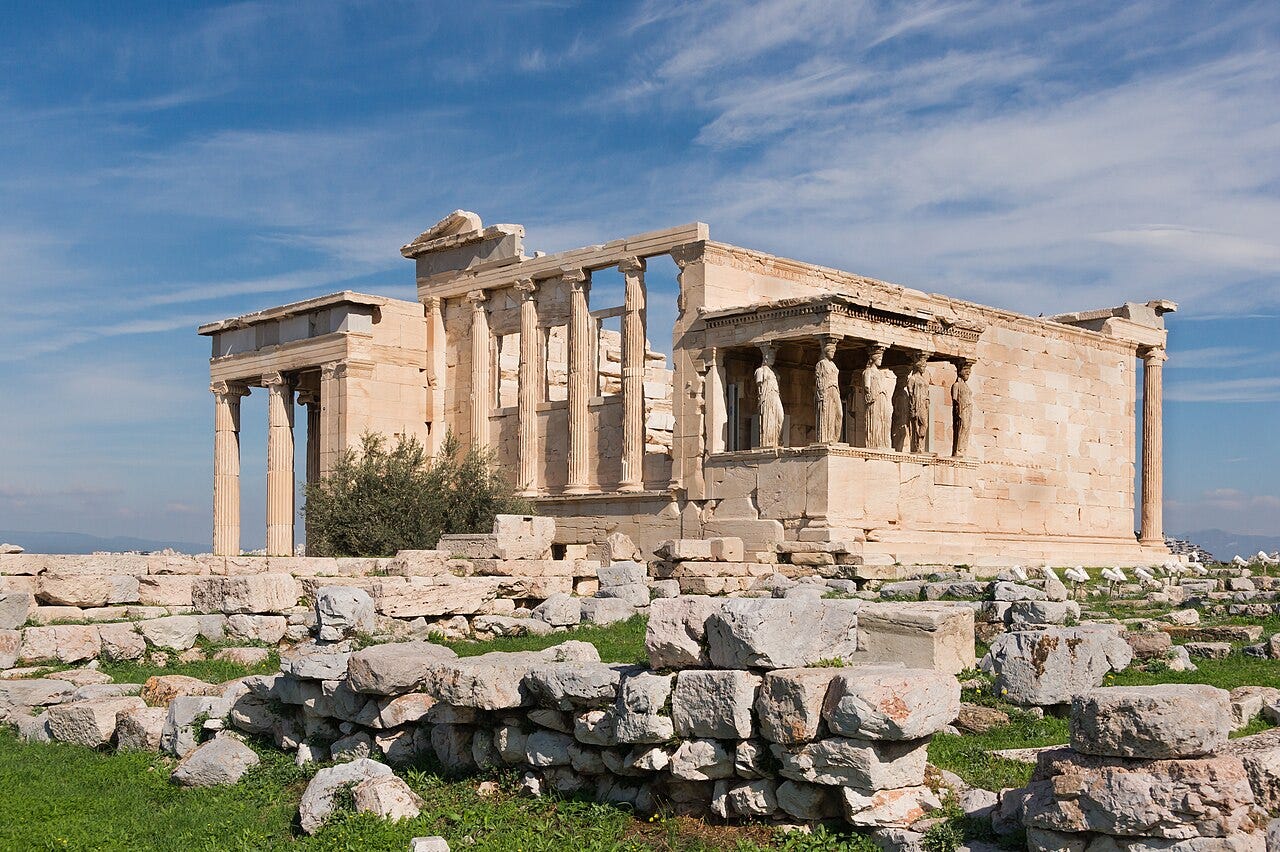
Featured Image: The Erechtheum, western side, Acropolis, Athens, Greece. (Jebulon / CC0 1.0)

My thoughts are that until Classical studies interrogates its own grand narratives and starts collaborating with disciplines beyond the textual, it will be deeply problematic whether or not it is enjoying a new surge in popularity…