


Table of Contents
From the Editor
For thousands of years, people on the island of Cyprus spoke a language that has since disappeared, leaving behind only a small number of inscriptions for us to study. Known as Eteocypriot, the language remains largely undeciphered, and its origins are still debated. But by taking another look at the surviving evidence, we may be able to uncover new clues about where this mysterious language came from and the people who spoke it.

Also this week, I sat down with Dr. Eric H. Cline to discuss his latest book, Love, War, and Diplomacy: The Discovery of the Amarna Letters & the Bronze Age World They Revealed. We explored how the Amarna Letters were discovered, the drama surrounding the race to acquire and translate these ancient tablets, and what the letters actually revealed about the Bronze Age world.

If you haven’t already, be sure to check it out!
Ask Me Anything
It has been a while since I have done an Ask-Me-Anything video, so, now is your chance to start asking your ancient history focused or Digging Up The Past questions! And once I get enough, a new video will be recorded!
In the News
2,600-Year-Old Cretan Armor Returns Home
Five pieces of ancient Cretan armor, including two bronze helmets and three protective body guards, are returning to Greece more than 60 years after they were illegally excavated from Afrati. Dating to the late seventh century BCE, the pieces were traced through archaeological records and investigations and will now be reunited with related finds already housed in Crete. Source: Greek Reporter.
A Treasure-Filled Etruscan Tomb at Vulci
Archaeologists at ancient Vulci in Italy have uncovered a monumental seventh-century BCE Etruscan tomb containing an impressive collection of pottery, weapons, chariot parts, gold, bronze, ivory, and personal items. Despite being disturbed by looters in the 20th century, parts of the tomb remained remarkably well preserved, giving researchers a rare look at the wealthy elite of Vulci. Source: Archaeology Magazine.
An Ancient Roman Kitchen in Spain
A 2,000-year-old Roman kitchen has been uncovered at ancient Segisamo in Spain, complete with cooking pots, storage vessels, mortars, and fragments of a portable oven. Some of the pottery was imported from Italy while other pieces were locally made, showing how Roman cooking practices blended with older local traditions. Source: Archaeology Magazine.
A New Piece of the World’s Oldest Peace Treaty
Archaeologists at Hattusa, the ancient Hittite capital, have discovered another fragment of the famous Kadesh Peace Treaty between Egypt and the Hittite Empire. The roughly 3,300-year-old fragment contains part of the treaty dealing with refugees and the protection of their homes, adding another fascinating piece to one of history’s earliest international peace agreements. Source: ZME Science.
A Roman Soldier Gives Thanks for Making It Home
A 1,750-year-old altar discovered at Binchester Roman Fort was dedicated by a soldier named Eltaominus to Fortuna Redux, the goddess associated with safe returns from dangerous journeys. The inscription suggests he considered Binchester home, and the altar was placed inside the fort’s bathhouse as a thank-you after his safe return. Source: Archaeology Magazine.
Quote
Jealousy is both reasonable and belongs to reasonable men, while envy is base and belongs to the base, for the one makes himself get good things by jealousy, while the other does not allow his neighbour to have them through envy. - Aristotle
Last Week’s Comic Submissions
No submissions.
Trivia Question
Last Week’s Trivia Answer
The Antikythera Mechanism was used to predict astronomical events.
Halloween Sale on Annual Subscriptions
Digging Up The Past is offering a Halloween promotional sale which ends on October 31st. Is it a bit early for a Halloween promotion? Nope! It is never too early for anything Halloween. 😄 Be sure to not miss out on getting 20% off annual subscriptions for all eternity! Mhua ha ha ha!
Your subscription helps support the interviews, videos, and other content that make this site possible. Many of the tools, resources, and guest appearances come with a cost, so your support really does make a difference.
Thanks for being here and helping me keep creating and sharing more with you!
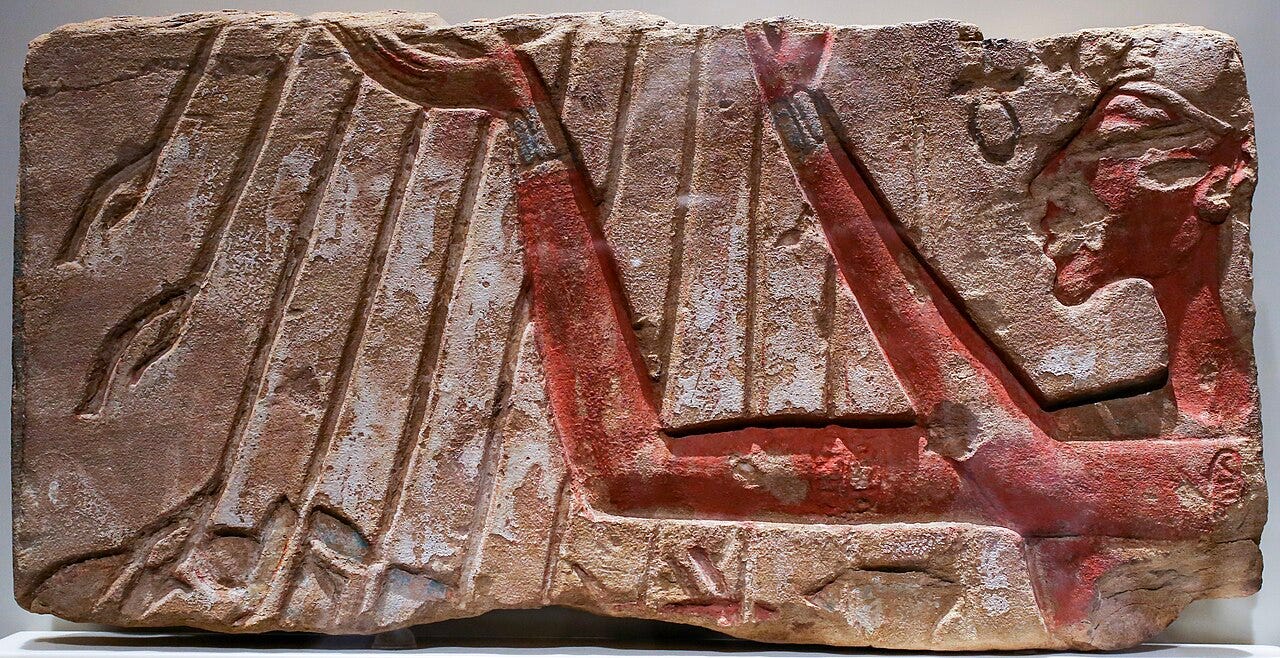
Featured Image: Akhenaton raising his hands to the sun god, Aton. (ArchoiOptix / CC BY-SA 4.0)
.jpg)